City of the Century by Donald L. Miller
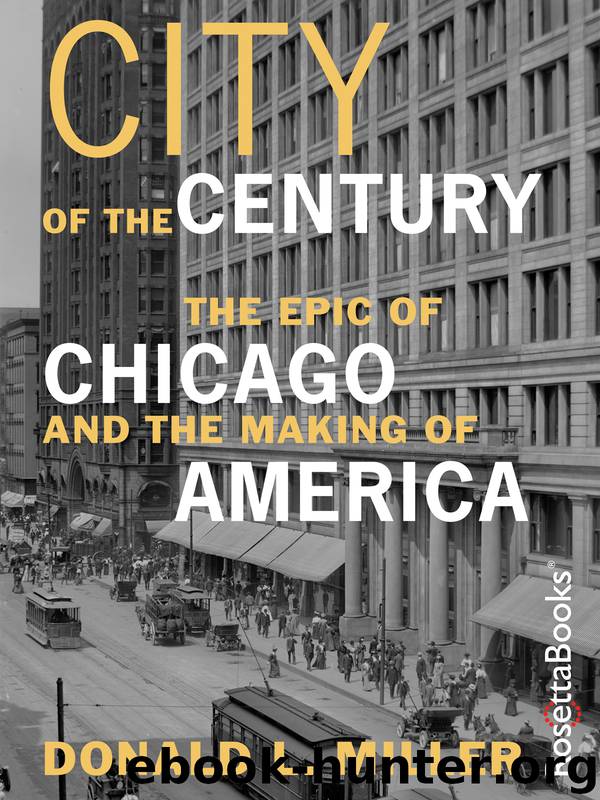
Author:Donald L. Miller [Miller, Donald L.]
Language: eng
Format: epub
ISBN: 978-0-7953-3985-1
Publisher: RosettaBooks
Published: 2014-04-10T04:00:00+00:00
4. Factories in the Sky
“Fifteen years ago, there was no such thing as an office building known in Chicago,” John Flinn declared in one of his popular guidebooks to the World’s Fair city. “Today… the stranger in his travels about town is impressed with the idea that the business of Chicago is done in offices… known as ‘Sky Scrapers.’… What all the people who occupy the [skyscraper] offices do,” Flinn added, “will be a source of wonder to the visitor.”
Flinn’s guidebooks took visitors to Chicago where insistent elevator captains would not permit them to go—into the business heart of the skyscraper. Peeking over the transoms, so to speak, he gave many of his readers their first glimpse of modern office work, with clerks and managers, their desks set in long, closely spaced rows—as at Armour’s headquarters in the Home Insurance Building—working at a nonstop pace, the air alive with the clicking of telegraph keys, the ringing of telephones, and the unfamiliar clatter of a machine new to American business.
The typewriter was both a response to and a cause of a transformation in capitalist office procedure that began about the time the Montauk Building was designed, an “office revolution” that accompanied the architectural revolution that gave America the tall business building. As businesses expanded tremendously and consolidated with other firms, they had need, as we have seen, for larger and more centrally located offices. In turn, the increased size, scope, and complexity of business operations led to an extraordinary increase in paperwork—a veritable “paper empire”—and increased the need for faster communication and more efficient means of record keeping. Two new pieces of office technology—the typewriter and the vertical file cabinet—helped answer these needs and, with the skyscraper itself, symbolized a break with older forms of capitalism and the beginning of what historian Oliver Zunz has called “bureaucratic rule and hierarchy.”
In the skyscraper offices of big corporations readers of Flinn’s guidebooks could see, through the author’s practiced eye, a system of getting out the product not unlike the killing line at Armour’s pork plant. An architectural expression of the new separation of factory and office, the skyscraper also became a new kind of factory, with a white-collar proletariat made of young unmarried women, who, like their earlier factory-floor counterparts in the textile mills of Lowell, Massachusetts, expected to work only a few years before marrying and becoming homemakers.
As at Armour’s plant, the originating agency of change was the division of labor necessitated by the increased size and scale of modern business and the competitive pressures to keep down prices and labor costs. But while there was almost no labor-saving technology in the packing plant, new technology, principally the typewriter, had a trans-formative role in the operation of the skyscraper office. By the turn of the century, this innocently intentioned machine had helped bring about a division of labor almost as destructive of workers’ independence and aspirations as Philip Armour’s “disassembly” line. Built by famous architects for empire-aspiring capitalists, the skyscraper was also the nine-to-five home of the new “office girl.
Download
This site does not store any files on its server. We only index and link to content provided by other sites. Please contact the content providers to delete copyright contents if any and email us, we'll remove relevant links or contents immediately.
| Africa | Americas |
| Arctic & Antarctica | Asia |
| Australia & Oceania | Europe |
| Middle East | Russia |
| United States | World |
| Ancient Civilizations | Military |
| Historical Study & Educational Resources |
Cat's cradle by Kurt Vonnegut(15357)
Pimp by Iceberg Slim(14508)
4 3 2 1: A Novel by Paul Auster(12393)
Underground: A Human History of the Worlds Beneath Our Feet by Will Hunt(12099)
The Radium Girls by Kate Moore(12028)
Wiseguy by Nicholas Pileggi(5787)
The Fire Next Time by James Baldwin(5447)
Perfect Rhythm by Jae(5404)
American History Stories, Volume III (Yesterday's Classics) by Pratt Mara L(5308)
Paper Towns by Green John(5191)
Pale Blue Dot by Carl Sagan(5008)
A Higher Loyalty: Truth, Lies, and Leadership by James Comey(4964)
The Mayflower and the Pilgrims' New World by Nathaniel Philbrick(4504)
The Doomsday Machine by Daniel Ellsberg(4490)
Killers of the Flower Moon: The Osage Murders and the Birth of the FBI by David Grann(4447)
The Sympathizer by Viet Thanh Nguyen(4391)
Too Much and Not the Mood by Durga Chew-Bose(4348)
The Borden Murders by Sarah Miller(4325)
Sticky Fingers by Joe Hagan(4199)
